Twelve times over: the square metre Portugal already sold and Brazil hasn't discovered
A square metre in Lisbon costs twelve times a square metre in a Brazilian city centre. The gap isn't in the concrete, and it points to the country's most undervalued real estate
Start with the number that catches. The median residential square metre in the Lisbon municipality passed six thousand euros in early 2026. At six reais to the euro, that is 36,000 reais per square metre. Across the Atlantic, a used apartment in an emptied-out city centre or a mid-sized Brazilian city trades at 3,000 reais per square metre. The ratio is twelve to one. The same kind of old building, the same raw material, twelve times the difference per square metre. Translated into whole apartments: for the price of one flat in Lisbon, you buy eleven in Brazil's deteriorated urban cores.
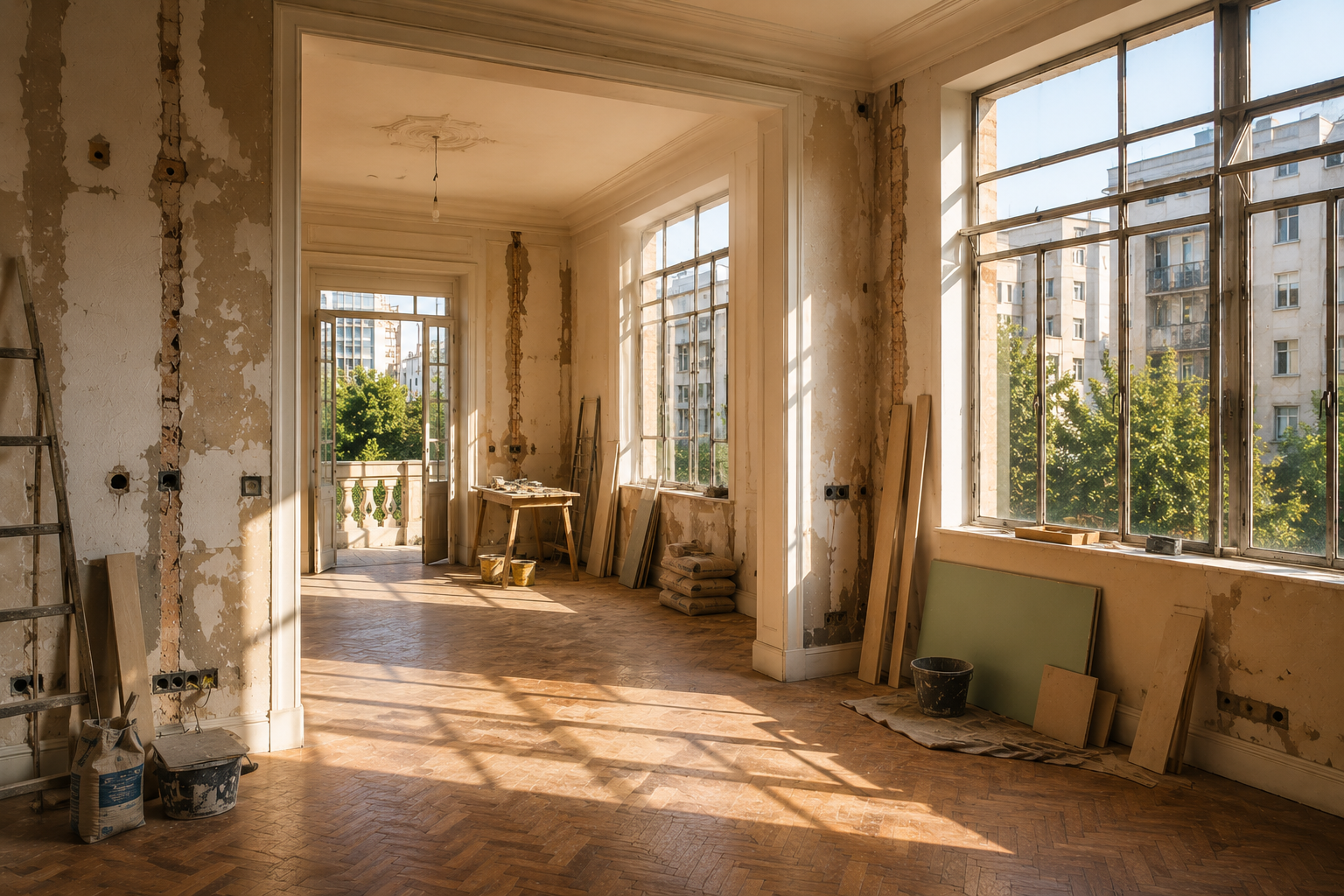
The number is arresting, but the number is not the point. The point is what it hides. The distance between these two square metres is not in the land, nor the location, nor the quality of the concrete. It is in the condition of the asset. The Portuguese property at six thousand euros embeds renovation, energy efficiency, urban context, and the institutional certainty that the neighbourhood has been recovered. The Brazilian property at three thousand reais is cheap because it is old, poorly maintained, with obsolete wiring and plumbing to redo, inside a building the market still prices as a problem rather than as raw material. The difference between the two is, in large part, recovery work not yet done. And undone work, to anyone who reads the market, is the technical definition of opportunity.
What Lisbon did between 2012 and 2026
Portugal lived exactly this arbitrage a decade ago, and resolved it. In 2019, entire buildings for rehabilitation in the city of Lisbon changed hands at around 2,760 euros per square metre for properties above five hundred metres, and 3,320 euros for smaller ones, according to Residential Information System data compiled by Cushman & Wakefield. These were degraded assets, many vacant, bought at ruin prices. By February 2026, the median square metre of finished housing in the capital reached 6,059 euros. The spread between raw material and finished product was captured by those who rehabilitated.
This did not happen by chance, nor by market miracle. It happened because the Portuguese state built the framework that turns discount into appreciation. The Exceptional Regime for Urban Rehabilitation, the RERU, approved by Decree-Law 53/2014, exempted rehabilitation works from technical standards written for new construction that, in practice, made recovering old buildings unviable. To that regime were added reduced VAT for rehabilitation works, exemptions from property and transfer taxes in urban rehabilitation areas, and a long-term municipal strategy, the Lisbon Urban Rehabilitation Strategy 2011-2024, which tied access to the tax benefit to the works being certified as rehabilitation by the municipality itself. The foreign capital that flowed in afterwards, from Miami to Frankfurt, paid the premium on the already-recovered property. Lisbon's recent appreciation did not come chiefly from new construction. It came from rehabilitation.
Where Brazil stands now
Brazil in 2026 is where Portugal stood around 2012. It has the stock, and it has the stock precisely in the depressed price band that matters. The historic centres of São Paulo, Rio, Santos, Recife, and Porto Alegre concentrate buildings from the 1940s to the 1970s, well located, structurally sound, underused or empty, traded at a depressed square metre precisely because the market still does not know what to do with them. It is the same pattern Lisbon and Porto displayed before the rehabilitation cycle. The difference is the framework, and the difference is decisive.
There is a case that anchors the thesis in concrete work, not theory. In central São Paulo, the developer Somauma, through the Refúgios Urbanos brand, bought the Edifício Virginia, a 1950s building from the former Matarazzo family estate. The original forty-seven apartments, from 161 to 182 square metres, were transformed into one hundred and twenty-one units of 26 to 182 metres. The operation cost around 60 million reais, against a gross sales value of 110 million, with eighty per cent of units sold before delivery. The gross spread of sales value over cost landed near 1.8 times. The math closes, and closes well.
The same developer names the bottleneck with surgical precision. The square metre to produce housing in the centre costs about 7,000 reais, which still puts a thirty-metre apartment at 210,000 reais, above what the target income bracket can bear. And, more tellingly, credit and legislation were designed for traditional development. In trying to fit a retrofit project into existing housing programmes, the developer runs into rules written for new buildings, with requirements such as minimum leisure area that old compact-floorplan buildings cannot meet. It is precisely the problem the Portuguese RERU solved in 2014, exempting rehabilitation from standards conceived for new construction. Brazil still treats retrofit as if it were building from scratch, and in doing so, keeps the discount on the table.
The caveat that separates analysis from promise
None of this is easy money, and it is worth saying plainly. The cost of retrofit in Brazil is not trivial. Market ranges for heavy renovation in São Paulo run from 1,500 to more than 5,500 reais per square metre, and buildings over twenty years old frequently require full replacement of electrical and plumbing systems, a silent surcharge of twenty to thirty per cent on the budget. In an old building with structure, installations, and risers to redo, the cost of rehabilitation can approach the cost of new construction. The thesis is not to buy cheap and resell dear with no effort. The thesis is that the entry discount, buying at 3,000 reais per metre an asset whose rehabilitated equivalent holds far above that, is large enough to absorb a well-executed retrofit and still preserve spread, as the Virginia case demonstrates in practice.
What Brazil lacks is not demand, nor stock, nor precedent. It lacks the framework. It lacks the Brazilian RERU, the credit designed for rehabilitation, the tax exemption conditioned on certified works, the long-term municipal strategy that signals to private capital that the centre will be recovered. Portugal took roughly a decade to walk the path between 2,760 and 6,059 euros per square metre. Brazil faces the same interval, in the same raw material, with the advantage of already knowing the script. The square metre Portugal sold twice, once as ruin and once as recovered heritage, Brazil still sells only once. The difference between the two sales is the untapped market.
