Warapuru Hotel & Villa Estate (Itacaré, Bahia)
Capital Structure, Ecosystem Risk and the Anatomy of Stranded Ultra-Luxury Assets
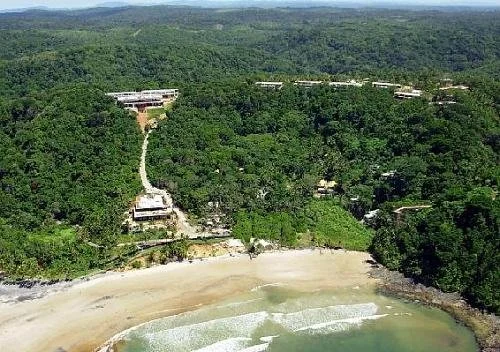
The Warapuru Hotel & Villa Estate in Itacaré, Bahia, was formally presented to investors in November 2008 through a structured investment memorandum titled “Warapuru Hotel & Villa Estate – Investor Presentation – November 2008”, associated with Miguel Guedes de Sousa and the development company Harmattan Ltda. The original investor presentation remains publicly accessible and serves as the primary factual source for understanding the financial and architectural ambition embedded in the project.
Unlike many unrealized developments that remain conceptual, Warapuru was supported by a detailed financial architecture. The project occupied approximately 80 hectares (800,000 square meters) within a private cove embraced by the Atlantic rainforest. The projected built area totaled roughly 70,000 square meters. The program included a 3,700 m² cliff-top reception building positioned 85 meters above beach level, a 2,150 m² spa integrated into the hillside with five ultra-luxury treatment rooms each featuring private pools, a 2,600 m² beach club with a 35-meter swimming pool, 40 independent bungalows ranging from 160 m² to 460 m² with private pools, and a 45-villa estate divided into three phases.
Phases 1 and 2 comprised 17 villas ranging from 950 m² to 2,300 m². According to the investor deck, these units had been pre-sold at prices reaching up to US$ 4.6 million per villa. Phase 3 was structured as a 28-villa development with an average size of 900 m², projected development costs of US$ 71 million, projected total sales of US$ 176 million, and an estimated profit of US$ 105 million.
The stabilized Year-5 operational model assumed 40 bungalow units and 148 “villa rooms available,” totaling 188 commercialized units. Projected occupancy was 65% for bungalows and 25% for villas, with average daily revenues of US$ 900 and US$ 3,940 respectively. The model included a 50% revenue distribution to villa owners. Based on these assumptions, projected annual EBITDA was US$ 10.6 million. Applying a 10% cap rate implied a terminal valuation of US$ 85.6 million for the hospitality component.
From a purely financial modeling perspective, the structure was coherent. It combined development margin from villa sales, operational income from hotel inventory, and asset capitalization through terminal value. On paper, the mathematics were internally consistent.
However, Warapuru did not reach operational maturity. Construction was halted amid environmental licensing disputes beginning in 2007. Legal challenges involving regulatory approvals interrupted execution at a stage when the project was already reportedly 65% completed. The delay undermined capital continuity and introduced uncertainty into what had been presented as a lower-risk profile due to sunk costs and advanced construction.
By 2011, Harmattan Ltda., the development company, faced bankruptcy proceedings initiated by creditors. The project entered a prolonged period of inactivity. Attempts at recapitalization and external investor participation did not ultimately lead to reopening. Today, the site remains unfinished and abandoned. Physical structures, reception, spa bases, beach club shells, partially completed bungalows, remain visible but deteriorated. Vegetation has overtaken large portions of the development footprint. The project has not been revived into operational status.
Warapuru therefore transitioned from an ultra-luxury destination thesis to what can be classified in asset-management terms as stranded capital. The capital deployed generated neither stabilized operational income nor realized terminal valuation. The financial model was constructed; the ecosystem alignment was not sustained.
This case becomes clearer when compared with other Brazilian hospitality developments. Txai Itacaré, located in the same municipality, followed a more incremental development path, scaling gradually and operating within a narrower capital structure. Fasano’s expansion strategy in Brazil has typically prioritized phased openings in consolidated urban markets before entering more complex destinations. On the other end of the spectrum, certain large mixed-use coastal projects launched during the 2006–2012 cycle faced similar difficulties when regulatory friction, infrastructure gaps or macroeconomic deceleration interrupted execution. The pattern is consistent: ultra-luxury assets in emerging markets require not only architectural ambition but long-term regulatory stability, deep international demand, and resilient capital structures capable of absorbing delays without collapse.
Warapuru’s investor memorandum framed sunk cost and advanced construction as risk mitigation. In practice, sunk cost becomes an advantage only when execution momentum continues uninterrupted. When regulatory processes introduce prolonged suspension, fixed capital becomes exposed, financing structures tighten, and pre-sales confidence erodes. The longer the interruption, the more the internal rate of return compresses. Ultra-luxury assets are particularly sensitive to this dynamic because their revenue model depends on high ADR, brand positioning, and uninterrupted narrative credibility.
From a capital allocation standpoint, Warapuru offers a precise lesson. Financial models must be stress-tested not only for occupancy volatility and ADR sensitivity, but for regulatory duration risk and capital continuity risk. A delay of 24 months in a development structured around phased sales and terminal valuation can materially alter equity returns. If the project cannot sustain extended non-revenue periods, even a well-constructed EBITDA projection becomes irrelevant.
Today, Warapuru stands physically incomplete. It has not resumed construction. It has not been repositioned. It remains associated with prior legal disputes and bankruptcy proceedings tied to its original development company. Its structures have deteriorated over more than a decade of inactivity. The gap between projected EBITDA of US$ 10.6 million and actual operational income effectively zero, defines the difference between financial architecture and realized asset performance.
At Latitude3, projects like Warapuru are not examined with hindsight superiority but with structural discipline. The purpose of analyzing such cases is not to judge ambition but to evaluate synchronization between capital deployment, regulatory frameworks, infrastructure readiness and market depth. Ultra-luxury hospitality assets can succeed in Brazil. Several have. But success depends on sequencing, not merely scale.
Capital without ecosystem alignment becomes stranded capital. Capital aligned with timing, regulation and market depth becomes resilient capital. The difference lies in the rigor applied before execution.
