A memory of Ayrton Senna carried across 88 countries. ✈️
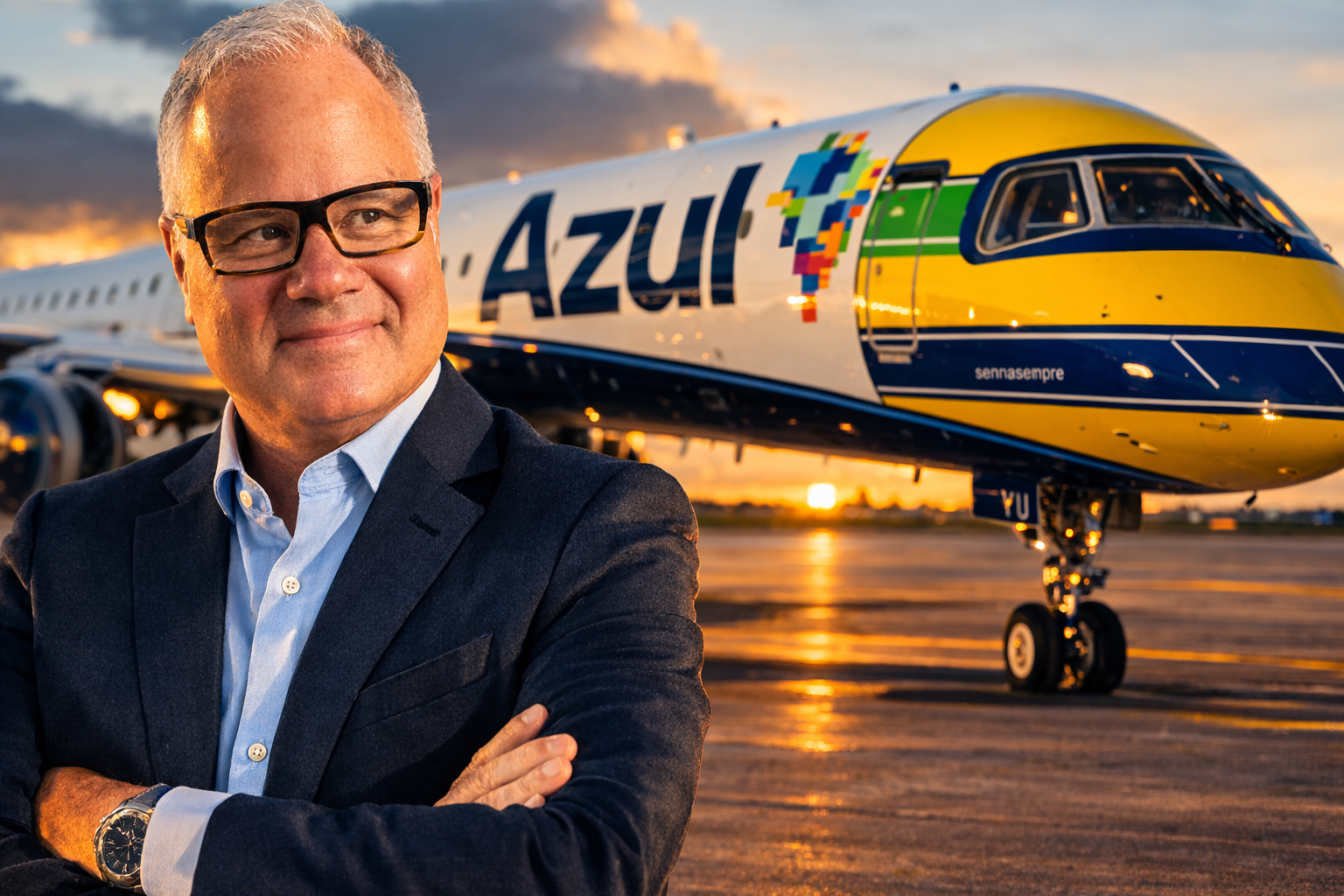
In every profession there are tasks that must be done and responsibilities that must be fulfilled. Organizations depend on structure, planning and discipline to operate. Yet from time to time something remarkable happens inside a company, something that was never written in a job description.
It happens when someone decides to go beyond what is required.
One of those moments occurred inside Azul Linhas Aéreas through the initiative of aviation executive Gianfranco Beting.
Within the Brazilian aviation community, Gianfranco is widely known by a nickname: Panda. The name was given to him by Omar Fontana, one of the great pioneers of commercial aviation in Brazil and a figure whose entrepreneurial spirit helped shape an entire era of the industry.
The nickname reflects something deeper than familiarity. Aviation has always been a world built on relationships, shared stories, and a profound respect for those who dedicate their lives to flying. In that environment, Gianfranco became known not only for his professional work but also for his genuine passion for aviation.
That passion led to an idea that would eventually travel the world.
The proposal was simple yet powerful: to create a special aircraft honoring Ayrton Senna, one of the most admired athletes in modern history. The aircraft would carry the colors of Senna’s iconic helmet yellow with green and blue stripes a symbol instantly recognized across continents.
But the idea itself was never the difficult part.
Turning it into reality required initiative.
Gianfranco personally traveled to Porto Alegre to speak with the company responsible for the aircraft’s maintenance and painting. Stopping an aircraft for a custom paint job involves time, logistics, and cost. It was not something the company had planned.
Still, he persisted. A partnership was proposed. The painting would move forward, and the aircraft would become a tribute not only to Senna but also to the spirit of Brazilian excellence he represented.
When the aircraft was finally ready, an event was organized in Porto Alegre to present it to the public. Journalists were invited, and among the guests was Viviane Senna, who has dedicated much of her life to preserving and expanding the legacy of her brother.
During the preparations, an extraordinary coincidence emerged: A married couple flying for Azul had once served as the pilot and co-pilot of Senna’s private jet during his career. At that moment they were simply scheduled on regular flights within the airline.
Gianfranco decided to turn that coincidence into something unforgettable.
The pilots were quietly removed from their scheduled flights and invited to attend the ceremony. At the right moment, they entered the room in uniform.
When Viviane Senna saw them pilots who had once flown with her brother the emotion was immediate. For a brief moment the past and the present seemed to meet in the same place.
After the ceremony, Gianfranco boarded the tribute aircraft back to São Paulo. During the flight he sat beside Viviane Senna. Later he would describe how much of that journey passed in quiet reflection, both of them moved by the meaning of what had just happened.
The following day, images of the aircraft began to circulate internationally.
The tribute appeared in aviation publications, news outlets and social media across the globe.
Within days the aircraft had been featured in 88 different countries.
Among the many reactions, one comment captured the spirit of the tribute perfectly:
“Finally, the fastest aircraft in aviation.”
It was a poetic remark. Not because the aircraft was physically faster, but because it carried the memory of someone whose pursuit of excellence had inspired millions.
Stories like this remind us that organizations are ultimately shaped by people. Strategies matter. Structures matter. But sometimes the most powerful gestures emerge simply from passion.
The aircraft honoring Senna was never a mandatory project.
It was an act of admiration.
An act of memory.
And ultimately, an act of love for aviation.
When people bring that kind of dedication to their work, the results often travel farther than anyone could have imagined.
Sometimes, they travel to 88 countries. ✈️
